
This year was packed with a variety of adventures (and I’m not quite done, as we’re in Yellowstone over the holidays), from scouting trips to tours. I hit four different continents—that includes Africa and South America twice each—and saw a wide array of species. And yet…
It was not a great year for photography. Nearly every trip offered a wonderful shared experience with clients, but at the same time let me down in one sense or another. Either my big wildlife goal didn’t come through, or the general wildlife activity wasn’t all that high, or weather or travel logistics presented major problems. Really a mixed bag, and as a result, my Best Of list is rather small. But that means there are plenty of entries in the Not Quite Best list. These are moments that stood out, but either weren’t quite dynamic or amazing enough, or the resulting photos weren’t good enough by my standards.
You’ll find the Not Quite Best of the Year below, but be sure to also check back over the next week or so for both the Best of 2024 from my peers, and my own favorite images of the year.
January 9: Top Bird

I included this image in this list somewhat reluctantly. It’s a symbol of so many moments that went right, yet perhaps not quite as perfectly as I’d envisioned in 2024. The Harpy Eagle was my first big goal of the year, the top bird on my Bucket List. It was also my main reason for visiting Guyana, where a consistent Harpy nest site has been active for over thirty years. And yes, we found it, and frankly, this framing—within a square of criss-crossing trunks and branches—is a better photo op than I might’ve realistically hoped for. Yet, this is still just the chick (but what a cool looking chick!), not the massive dragon that is the adult Harpy Eagle. We waited for the adult to come in for three days, but never saw it. On the plus side, that still leaves a major goal for me when I return to lead my new Guyana tour in 2026!
As you can tell… a lot of conflicting emotions tied to this sighting. But when you add the #1 bird on your list, it deserves a place.
Join me on the 2026 Guyana: Land of Giants tour!
January 14: The Best Cock-of-the-Rock
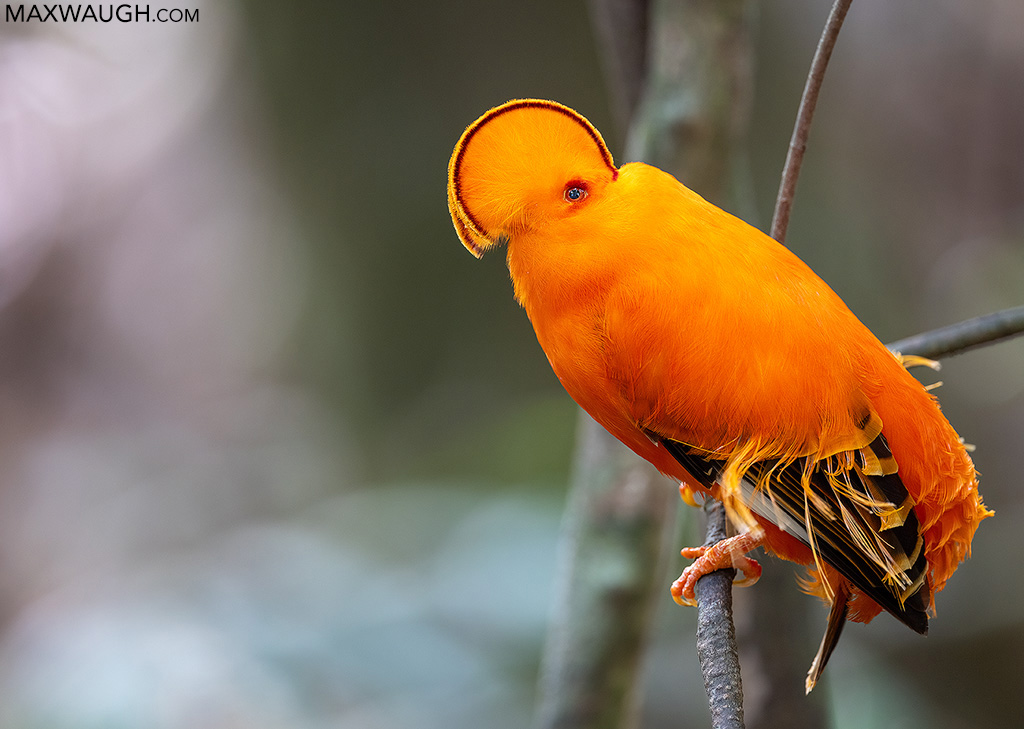
Back in 2012 I traveled to Peru and got some fleeting glimpses of the Andean Cock-of-the-rock. Definitely a cool bird, but I was disappointed not to get better photo opportunities with the brightly-colored males. This year, with my Guyana trip approaching, I knew I’d not only get another chance with the Cock-of-the-rock, but I’d actually get something better: a chance for the Guianan Cock-of-the-rock. Of the two species, this one is definitely more bizarre. That crest obscures most of the bird’s face, making it look rather alien-like (or, if you see it straight on with the diverging plumage over the beak, like a walrus). The tail feathers spray all over the place in little dangly noodles.
During my January scouting trip we visited a lek site and were not disappointed. There were several males around, and one in particular kept returning to a spot close to us in order to display and pine for females. It went better than I expected. Later in the trip, we found another spot with over a dozen males around. I came home knowing this was a new Top Ten Bird on my list!
See more bird photos from this trip.
March 10: Marsh Owl and Elephant

I’m always excited to add lifer owls to my list, and the Marsh Owl was a big surprise. I traveled to Kenya for the first time ever in March, and while I knew they had several owl species I had not seen, I wasn’t pinning my hopes on them. Especially the Marsh Owl, an elusive species I’d heard of in the past, but which I didn’t think I’d ever encounter due to timing or geography.
So as we explored Tsavo for the first time it was a major surprise to see our first. Even more surprising was that it’s basically the African version of our northern Short-eared Owl: same size, body shape, and especially flying motion (that dipping movement during a slow flap was instantly recognizable)… but with darker plumage and dark eyes.
One evening we returned to the area where we had seen the owls, but were distracted by a large herd of elephants at sunset. Just after the sun went down, a couple of owls swooped close. It was tough, in the dark conditions, to land anything sharp. This one turned out okay at web resolution at least (I think client Steve has a better version). I doubt I’ll ever see a Short-eared with an elephant in the background!
See more bird photos from Kenya.
May 31: A View to a Kill

One of the biggest challenges for me in recent years is juggling my work and home schedule. I’ve done my best to make sure my travel slate doesn’t become oversaturated, often cutting short or eliminating trips and tours when I have to add something else to the schedule. With the late addition of a Kenya tour in June, I had to trim my spring Yellowstone trip, which severely reduced my solo time exploring the park. On one such morning I made a goal of visiting the Lake area one morning , but I kept getting distracted along the way (as detailed in my trip report).
When I finally did arrive in the area where grizzly bears are known to roam, I found a small crowd that had been watching bears for some time. Apparently I missed the peak action earlier, when a bear family discovered and killed an elk calf. When I showed up, the sun was cresting the hillside and shining right in our faces… making it very difficult to see, much less focus the camera on anything. The scene that was playing out was actually still quite interesting, though it wasn’t nearly as action-packed. The bears sported some nice rim-lighting, and the elk cow was still circling in the area, wondering if her calf had somehow survived (or perhaps instinctively hoping to lead the predators away from it).
There were some moments I really wish had turned out in the camera, but I had an extremely hard time focusing on those rim-lit bodies (something I’ve noticed mirrorless cameras struggle with). So in some ways I’m reminded of the missed opportunity. On the other hand, I think this scene tells a far more interesting story than some of the more aesthetically pleasing moments, and feels more unique to me than just a kill shot.
See more photos from my 2024 Yellowstone trips.
July 24: Morning at the Tower


Brazil was the trip that was supposed to set everything right. There was no doubt that we’d see a ton of wildlife there, and I assumed that meant we’d score some major highlights. Well, we did see a lot, and there were highlights… though for me nothing so unique and outstanding for it to make my Best Of list. But, there were a lot of runner-up moments.
Two years ago, a surprise visit from white-cheeked spider monkeys made this list. This year, we were back in the same spot, stationed 50 meters above the rainforest floor in the Amazon, waiting to see what would visit the trees near our canopy tower lookout. It didn’t take long for the show to start, and then the animals kept coming. We got great views of vibrant beauties like the Black-faced Dacnis, Curl-crested Aracari, Black-thighed Parrots, and other birds. And then monkeys showed up! First tufted capuchins, but we also got distant views of the endangered white-nosed saki. I’ve been in this tower several times now, and it never disappoints, but this was probably my best session there to date.
See more bird photos from this year’s Brazil trip.
July 27: There’s Small, and Then There’s Tiny


I was already starting to feel the familiar strain again: we had chugged along on my Brazil trip without any major, rare standout wildlife encounter (from my seasoned perspective, it’s harder to find new experiences), and thus far our first stop in the Pantanal had been relatively quiet. I hoped like heck for a chance giant anteater sighting. Heck, even an armadillo would get the clients’ juices flowing, but those were oddly absent too. I had nearly written off any chance of seeing black-tailed marmosets, the tiny, adorable monkeys found in this area. My guide had told me they were no longer around.
Then, just as I was starting to deflate, our driver spotted them: marmosets! We have a chance to see quite a few primates during the Brazil trip, including a couple of endangered species, but the marmosets are by far the smallest and cutest monkeys we can find. So this was a big score. Even better though, they had a new family member. This baby was estimated to be only a couple days old. We were very fortunate to get a couple of open glimpses, and we were able to witness the behavior unique to only some smaller primate species: Dad does most of the heavy lifting. When we first spied the little one, it was riding on the back of a male. It was only when it was time to feed that Mom came over and took the tyke, then proceeded to nurse as the sun set behind us. This ended up being my highlight of the entire trip.
See more wildlife photos from this year’s Brazil trip.
July 29: Garden Gnome

Following a morning expedition searching for jaguars in the Pantanal, we returned to the lodge for lunch and a midday break. I was approaching my room when I looked at the side of the building and spied something out of place. This capybara was sitting there, completely still, looking like the world’s largest garden ornament. I couldn’t help but laugh, and snapped a picture with my phone that was more interesting than most of the shots I took with my cameras that day.
July 30: Water Tank

One of the largest birds seen during my Brazil tours is the massive Jabiru stork. They’re rather imposing (especially when they fly right past your canopy tower viewpoint), and quite distinct. They also possess an interesting physical characteristic: a bulbous throat pouch. Even when it’s not engorged, the bulging neck is pretty distinct, but this was downright ridiculous.
So what’s the pouch all about it? It’s actually full of water! Jabirus can store water in their throat and transport it back to their nests into order to douse chicks that may be baking in the hot sun. I had never seen a Jabiru this laden down with water before. It looked positively alien.
The only issue with the photo? The subject was a bit far, and I had to crop down significantly. Still, with a pass through some upsizing software it was good enough even for print, and landed on the cover of my annual yearbook magazine.
August 4: Seattle Summer

Aside from the basic idea of spending more time away from family, my biggest problem with scheduling too many trips between June and September is that I miss too much of our wonderful Seattle Summer.
Summer is the best time of year to be here, and despite what we were taught 30-40 years ago, it does last a decent chunk of time. So I hate to miss it. This photo, snapped with my cell phone during a family day at the beach, encapsulates a couple of Seattle traditions: hanging out on Lake Washington and the Blue Angels. It was great to get several weeks of R&R in domestic sunshine before heading back out into the wild.
September 25: Respite from the Rain

So where did I go when I left the last vestiges of summer behind? Somewhere that typically gives you the full autumn experience: the Great Bear Rainforest! And boy, was this year’s trip wet. It took a few days before things finally cleared up, and even that was a brief interlude before the next showers arrived. But we tried our best to take advantage of the dryer conditions to snap some pictures before our lenses and cameras fogged up again.
As we puttered along in one of this region’s many picturesque inlets, a resting harbor seal eyed us warily. In this case I was entranced more by the background, blanketed in a more benign moisture layer that gave the setting a peaceful but eerie mood, and hinted that we weren’t quite clear of nature’s wrath just yet. Soon we were sheltering in place waiting for the next storm to pass by.
See photos from the 2024 Great Bear Rainforest trip.
November 12 & 19: Those Elusive Cats


It’s very tempting to push things as far as you can to get the dream sighting you (or your clients) are hoping for. Especially when you know it may be a once-in-a-lifetime moment. And especially when things haven’t been super active in the field.
We were faced with such temptation in Mongolia, during recent my cat-centric tour. We started in the eastern steppe looking for Pallas’s cats, and for whatever reason—perhaps the long grass, or a dip in prey animals—sightings weren’t as easy to come by as they were two years ago. Yet when we did find a cat, we kept at a respectful distance, and didn’t send our spotters or guides in to rouse the animal and make it run. Instead, we waited and let our subjects move in their own time. Sometimes Pallas’s cats don’t move at all, and usually when they do, they turn directly away from you and give you a nice view of their butt on their way out. In the case of one feline found between two boulders, we lucked out, as it decided to leave via the front of its short tunnel, which gave us some clear profile views as it departed. It’s not a fully clear view, and it’s not a dynamic action shot, but that would be fake anyway. This glimpse of the animal blending in so well to its environment is actually pretty good, and a much better depiction of what it’s like seeing them in the wild.
Snow leopards are equally elusive, and we worked hard to get into a position where we could see one napping while exploring the Altai Mountains during the second half of the trip. It was a perfect setup… if the cat decided to get up and move. Once again, this is a situation in which many groups would send their guide in to “rouse” the cat. Make it stand up, change positions: just go anywhere so the photographers can get a clear shot. But to the credit of my group, they didn’t want that. So we waited. All day. And ultimately, after the sun dipped behind the horizon, the cat stirred. But it simply peeked out at us briefly before settling back down. Yes, I got a clear shot of a snow leopard on this trip, but in some ways this encounter was more satisfying knowing that we showed ultimate respect to the animal and let it remain as master of its domain.
Stay tuned for more of my Year in Review content, including my Best of 2024 photos coming next week!
More Year in Review Content
Also see:
Sharing the Top Work from 2024 from My Peers
My 2024 Favorites in Entertainment and Literature
See my favorite images from other years

Purchase PHOTO/24, my annual photo yearbook. This year’s issue is 64 pages and contains dozens of images from my various adventures, including my Best of 2024 selections. $19.99 for the print magazine, $6.99 for a digital copy. Purchase a copy of PHOTO/24 here.


